

Jessica took this photo on a Sunday. Most days I’m in my Climate Control Solutions work shirt covered in HVAC dust, but she insisted on at least one “presentable” photo for the blog.
About me
5:45am. Coffee’s brewing. Air fryer’s already on the counter.
My daughter thinks I make Chinese food in a robot. She’s not entirely wrong, I use it for pretty much everything. Orange chicken on Tuesday. Potstickers on Thursday. 春卷 (chūn juǎn, egg rolls) whenever Lily demands them, which is often.
Name’s Garrison Chen. I spend my days fixing furnaces and AC units around Fargo, the unglamorous side of making sure people don’t freeze through North Dakota winters. Moved to Fargo after finishing my HVAC degree at North Dakota State College of Science because the housing was affordable and Climate Control Solutions was hiring.
Three years back, I was hemorrhaging $400 a month on Chinese takeout because I couldn’t figure out how to get that crispy texture at home. Then Tom, a coworker, brought egg rolls to our company potluck, and I realized the secret was just controlled heat.
That’s how it started recreating my dad’s Chinese recipes from San Francisco. But once I understood the temperature science, I started applying it to everything. Italian chicken parm, buffalo wings, French fries, if it’s supposed to be crispy, the same principles apply.
This blog launched in November 2024 because working parents shouldn’t have to choose between authentic-tasting food and actually having time for their families. Also because my wife Jessica got tired of our grocery budget disappearing into takeout containers Chinese, Italian, you name it.
Now MY family saves $250 a month. Lily stands on her step stool, hands me ingredients, and ceremonially presses the air fryer start button announcing “Daddy, I helping cook Chinese food!” every single time. That’s exactly what I wanted her growing up connected to the same food traditions I had, even in the middle of North Dakota.
My Air Fryer Journey
- $9,000+ saved in my household since March 2022
- 1,000+ meals cooked over 3 years
- Every recipe tested minimum 3 times
- 22 minutes average weeknight dinner
- 1 skeptical Cantonese father won over
- Blog launched: November 2024
The $400 Wake-up Call
Jessica was grading papers when I came home with another bag from Golden Wok, March 2022. She looked at me and said, ‘We can’t keep doing this.’
She was right. We were spending more on Chinese takeout than our car payment. But I genuinely thought there was no other option, I’d tried making egg rolls at home before and they always came out soggy. Deep frying wasn’t happening, with a 1-year-old in the house.
Two weeks later, Tom brought 春卷 to the company potluck at Climate Control Solutions. I bit into one and immediately thought of Golden Dragon, my favorite takeout spot back in San Francisco. No joke, I cornered him by the coffee maker. ‘How’d you make these without a deep fryer?’ He showed me a photo of his air fryer. I ordered one on Amazon the next morning.
First batch was a disaster. Soggy in the middle. Lily who was only 1 back then threw one on the floor. Even Buddy (our golden retriever mix) wouldn’t eat it. Jessica gently suggested maybe we should stick to takeout.
But I fix HVAC systems for a living, I know how to troubleshoot. Treated it like a broken furnace. Adjusted the temperature from 350°F to 380°F. Started flipping them halfway. By the third attempt, they were perfect.
After three months of perfecting the recipe, I video-called my father while making a batch. He watched silently through the screen, measuring my technique the way he measures everything. Then he asked me to mail some frozen ones overnight.
I packed them with dry ice and sent them to San Francisco. A week later, my phone buzzed:
“Son, they’re pretty close. Not exactly like your 阿媽’s (grandmother’s), but pretty close.”
For my father, that was high praise. He’d spent three months insisting the air fryer was “not real cooking.” That text validated something bigger than a recipe, it proved I could maintain our cultural food heritage in Fargo, North Dakota, thousands of miles from San Francisco.
How I Actually Test Every Recipe
Here’s the deal: I approach recipe development the same way I diagnose a broken heating system.
When a furnace won’t heat, I don’t randomly try fixes. I test one variable at a time until I identify the actual problem. Temperature sensor? Thermostat calibration? Airflow restriction? Each variable gets isolated, tested, and documented.
Air fryer recipes get the same treatment.
My 5-step process:
- Adapt traditional recipe for air fryer constraints
– No wok = adjust for stationary basket cooking
– No deep fryer = compensate with higher temp + flip timing
– Standard 7-quart air fryer = must work for most people’s equipment - First test at estimated temperature and timing
– Document everything: temp, time, oil amount, flip timing
-Note texture, color, taste, any failures – Take photos (even the disasters) - Adjust ONE variable and retest
– Not “higher temp AND longer time”
– Just higher temp OR longer time
– This isolates what actually caused the improvement
- Repeat until it passes my three-judge panel
– Lily (age 4): Won’t eat anything with visible green vegetables
– Jessica: Refuses overly greasy food, prefers lighter versions
– My memory of San Francisco: Does it taste like what I grew up eating? - Final test with exact measurements before publishing
– Precise temps, precise timing, precise quantities
– Write troubleshooting notes for common mistakes
Real quick tip: Every recipe on this site includes a troubleshooting section at the bottom. That’s where I document what I messed up on attempts 1-2 so you skip straight to what works.
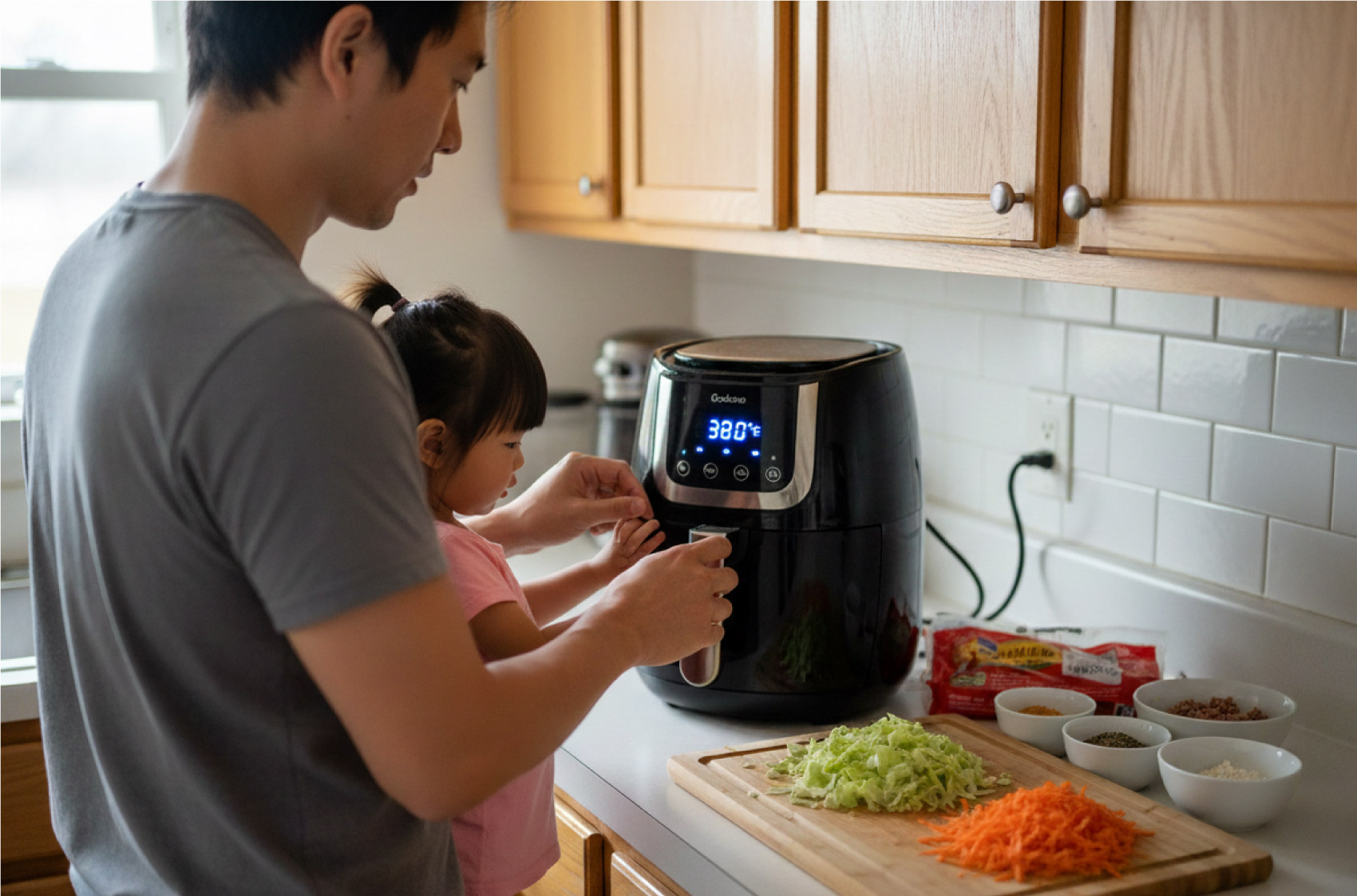
Sunday meal prep with Lily. She refuses to eat dinner unless she helps make it, which means she gets to press the air fryer start button.
I’m probably explaining why 380°F works better than 350°F.
This is pretty much every weekend at our house.
Beyond Egg Rolls
Started with Chinese food because that’s what I knew and what was draining our bank account. But once I nailed the egg rolls, Lily started making requests: “Can you make the cheese sticks from that restaurant?” “What about those crispy chicken things?”
Turns out, the same temperature principles that make perfect egg rolls also make perfect mozzarella sticks. And buffalo wings. And chicken parm.
My HVAC background means I approach every recipe the same way: figure out the target internal temperature, test the timing, adjust the variables. Whether it’s my dad’s potstickers or Jessica’s favorite Italian dishes, the methodology doesn’t change.
Current rotation: Chinese food 3-4 nights a week (Lily’s favorites), Italian once a week (Jessica’s choice), and whatever experiment I’m testing on the weekend.
Buddy (our golden retriever mix) has memorized the air fryer beeping sound and comes running from anywhere in the house hoping for dropped ingredients. He approves of all cuisines as long as something hits the floor.
Why Trust an HVAC Guy Over a Chef?
Fair question. I’m not competing with chefs, I’m solving a different problem.
Chefs create recipes in professional kitchens with proper equipment and hours of prep time. Their job is to make exceptional food.
My job is to make GOOD ENOUGH food in 22 minutes after a 10-hour shift, using ingredients from a regular grocery store, with a 4-year-old “helping” and a dog hoping for dropped ingredients.
What I bring that professional chefs don’t:
- Real constraints
50-hour work weeks at Climate Control Solutions (Monday-Friday, 7am-5pm, plus occasional emergency weekend calls). If a recipe takes more than 30 minutes total, I won’t make it.- Technical troubleshooting mindset
I diagnose broken systems every day. When a recipe fails, I don’t just “try again with a feeling.” I figure out EXACTLY what variable caused the failure and document the fix.- Standard home equipment
Everything tested in a regular 7-quart air fryer you can buy on Amazon, not professional convection ovens or commercial fryers.- Regular grocery store ingredients
If Hornbacher’s on 13th Avenue South doesn’t carry it, I don’t use it. No specialty Asian markets required.- Cultural insider perspective
I grew up eating this food in San Francisco. I know what it’s SUPPOSED to taste like, not what a cookbook says it should taste like.- Honest about limitations
These aren’t “authentic” traditional recipes. They’re Chinese-American comfort food adapted for real life. I’m not pretending to be my 阿媽 (grandmother). I’m just trying to make food that reminds me of home.
From San Francisco to Fargo: Why This Matters
I was born in San Francisco and grew up in a small apartment where my dad cooked traditional Cantonese dishes every weekend. The smell of 叉燒 (chāshāo, BBQ pork) and steamed rice would fill the whole building. Food was how we stayed connected to our heritage.
After finishing my HVAC degree at North Dakota State College of Science, I moved to Fargo because North Dakota had jobs and affordable housing. San Francisco’s rent was impossible.
But I didn’t learn to cook before I left. I just… ordered takeout.
For two years, Jessica and I spent $400/month on Chinese takeout. Lily was growing up eating restaurant food out of styrofoam containers, not home-cooked meals at the dinner table like I did.
The air fryer changed that.
Six months into my air fryer journey, Jessica sat down with our bank statements and realized we’d saved over $1,500. She came into the kitchen while I was making orange chicken and hugged me from behind without saying anything. That’s when I knew this was working, not just financially, but for our family.
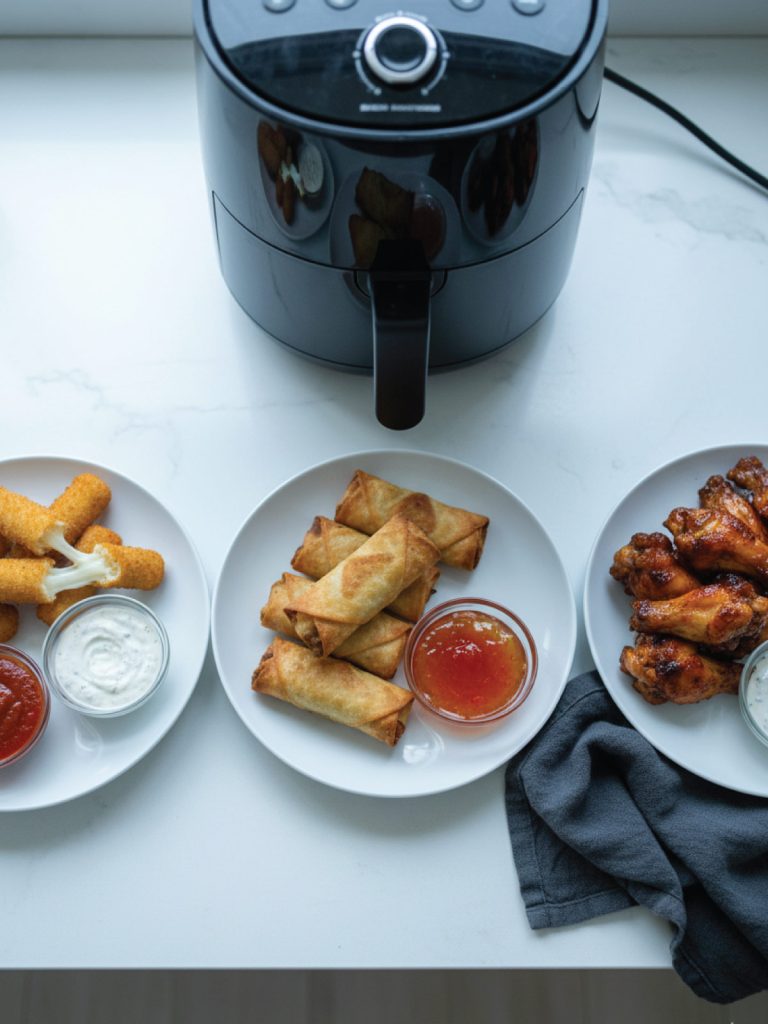
Three staples from the air fryer: egg rolls, mozzarella sticks, and
buffalo wings. All under 30 minutes total. Restaurant versions would
run you $40-50. These cost about $12 in ingredients from Hornbacher’s.
What’s Here
Air fryer versions of restaurant favorites, starting with the Chinese-American dishes I grew up eating, but now including Italian, American comfort food, and anything else that’s supposed to be crispy.
春卷 (chūn juǎn, egg rolls), chicken parm, buffalo wings, mozzarella sticks, potstickers. The kind of food that costs $15-20 per serving at restaurants, adapted so you can make it in 20-30 minutes with ingredients from Hornbacher’s.
Every recipe includes exact temperatures and timing because that’s what actually matters. Also troubleshooting sections at the bottom, that’s where I explain what I messed up so you don’t have to.
If you’re a working parent who misses the food you grew up with but doesn’t have three hours to spend cooking, this is for you.
Where To Start
Go with the egg rolls first. That’s what got me started, and they’re more forgiving than you’d think as long as you flip them halfway through, you’re golden.
After that, try the orange chicken. Takes 22 minutes and Lily will actually eat it, which is saying something because she refuses anything with visible green vegetables.
Trust me on this one: Don’t skip the troubleshooting notes at the bottom of each recipe. That’s where the actual useful information lives.
Full Transparency
- Blog Status: Launched November 2024
- Current readers: Growing from zero (you might be one of the first!)
- Recipe testing location: My home kitchen in Fargo, ND
- Air fryer: Standard 7-quart model purchased on Amazon in March 2022
- Grocery store: Hornbacher’s on 13th Avenue South
- Recipe development time: 3-6 weeks from first test to publication
- Affiliations: Some links on this site may be affiliate links. If you purchase through them, I earn a small commission at no extra cost to you. I only link to products I actually own and use daily.
- Recipe testing standards: Every recipe is made at least 3 times with documented temperature, timing, and results before publication. Troubleshooting notes include my actual failures so you know what to avoid.
Get In Touch
Questions about a recipe? Air fryer troubleshooting? Want to share your results?
Contact me here →
I post on Facebook and Pinterest when I remember, usually 2-3 times a week after making something worth documenting. Find me @airfryerplates.
Response time: 2-5 business days. I work full-time as an HVAC tech, so I respond evenings after Lily’s in bed and between HVAC service calls.